operation and calibration of refractometer
1.0 Purpose
1.1 To describe a procedure for operation and calibration of Refractometer.
2.0 Scope
2.1 This standard operating procedure is applicable for operation and calibration
of Refractometer in Quality Control laboratory at ABC Pvt. Ltd.
3.0 Responsibility
Officer QC/ Executive QC Preparation of SOP and follow the procedure as per SOP
Assistant Manager Reviewing and Training of SOP
Manager QC Implementation of SOP
4.0 Accountability
4.1 Manager Quality Control is accountable for implementation and compliance with SOP.
5.0 Procedure
5.1 Operation
5.1.1 Ensure that the instrument is clean.
5.1.2 Insert the plug of illumination assembly box and attach the illumination tubes to the
inlet provided on the left side of the instrument and to the adjustable clamp beneath the prism box using the small pin.
5.1.3 Turn on the illumination using the switch provided on the illumination assembly box.
5.1.4 To check the liquid samples, simply open the prism box now place few drops of the samples on the bower prism.
5.1.5 Now looking in the eyepiece focus accordingly simply by rotating the eyepiece in either direction.
5.1.6 After the sample is placed in the prism box. The refraction creates a shade in the crosswire box.
The shade is to be brought in the center of the cross-wine (where they intersect) using the scales
know located on the left side of the instrument.
5.1.7 Rotating the dispersion scale located on the right side in either direction, eliminate the
colour bands visible on the edge of the shade to attain sharp borderline.
5.1.8 For examining plastic bodies such as resin detach the lower prism & soften the material by
heat and smear a little on the exposed surface of the upper prism. To examine crystals or
glasses a specimen must be prepared similar to the standard list piece.
5.2 Calibration (Frequency: after 6 Months)
5.2.1 Ensure that all the parts including eye lens and prisms are clean before operation.
5.2.2 Turn on the illumination using the switch provided on the illumination assembly box.
5.2.3 Use thermometer and water jacket with tubes to make the constant temperature of sample compartment.
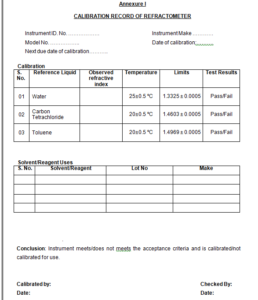
5.2.4 Open the prism lock and place few drops of distilled water at the temperature 25°C.
5.2.5 Allow the distilled water to smear on the lower prism surface quickly close the prism lock.
5.2.6 Adjust the eyepiece cross wire with a knob by rotating it in a clock wise or anti-clock wise
direction so that the sharp demarcation line passes through its centre.
5.2.7 Sharp demarcation is produced in the form of a circle having half-light and half dark portion.
5.2.8 Fine adjustment can be done by a knob provided just above the prism.
5.2.9 Note down the reading from the scale with the help of the magnified lens of the instrument.
5.2.10 Clean the instrument and repeat the procedure for carbon tetra chloride and Toluene measure at 20º±0.5° C.
5.2.11 Document the activity in Calibration Record Format (Annexure I).
5.2.12 Report any discrepancy observed during calibration of instrument to Quality Control
Manager or his designee for corrective and preventive action.
5.3 Cleaning
5.3.1 Clean the instrument after listing sample applies a small amount of acetone to cotton swap
and gently clean the prism. Use dry cotton or tissue paper wipe the prism make sure not to scratch the prism.
5.3.2 After use the instrument Clean and keep under cover.
5.4 Precaution
5.4.1 Handle the instrument properly.
5.4.2 Temperature should be carefully adjusted and maintained since refractive
index varies significantly with temperature.
5.4.3 Quality Control Manager or his designee informs the defect to Maintenance Department service
engineer to rectify the defect. Affix ‘Under Maintenance’ label on the instrument.
6.0 Reference
In House Specification
7.0 Attachments
Annexure I : Refractometer Calibration Format
8.0 Distribution
Distribution of the controlled copy to concerned departments.
Additional copies may be issued for specific purpose.
9.0 ABBREVIATIONS
QA : Quality Assurance
QC : Quality Control
SOP : Standard Operating Procedure
10.0 REVISION HISTORY
| Revision No. | Supersedes | Effective Date | Details of reason |
| 01 | Nil | New SOP |
Operating Procedure of Centrifuge
sop for preparation and storage of reagent solution
sop for Calibration and Maintenance of Laboratory Instruments and Equipment
Disposal of Residual Sample or Left Over Material
sop for for Laboratory Incident
standard operating procedure temperature monitoring
sop for operation of infrared moisture balance
sop for preparation of mobile phase
sop for Preparation and Issuance of Analysis protocol standard
sop of placebo and impurity stock solutions
sop for disposal of residual sample
sop for handling of pharmacopoeial changes
sop for procedure for operation of ultrasonic cleaner
difference between UPLC and HPLC
sop for for Emergency Eyewash and Shower
sop for operation and calibration of total organic carbon analyzers
sop for operation of cobb tester
sop for Operation and calibration of atomic absorption spectrophotometer
sop for Operation and calibration of gas liquid chromatograph
sop for operation of humidity oven
sop for operation and calibration of serological water bath
sop for monitoring of drain trap
sop for destruction of analytical samples after testing and control samples
sop for destruction of used chemicals
Sop for Operation of suction pump
sop for Operation and calibration uv cabinet
sop for Operation and calibration of bulk density apparatus
sop for operation and calibration of shore hardness tester
sop for operation of rub proofness tester
sop for monitoring of purified water
sop for Retesting of packaging materials
sop for Retesting and resampling of raw materials
sop for Control of issuance of record of analysis green sheets
sop for Control of computer passwords
sop for sampling of packaging materials PM
Operation and Calibration Procedure for pH Meter
Calibration of Melting Point Apparatus
Procedure For HPLC column washing procedure
Procedure For Retest Period of Raw Material
Procedure For Training Programme For Quality Control Personnel
Standard Operating Procedure is to provide guidelines for Preparation
Procedure For Analysis of Water rinsing
Procedure For Calibration of Glassware
Procedure For Procurement and storage of reference standards
Procedure For Preparation of buffer solution
safety guidelines for laboratory
responsibilities of quality control and microbiological department
responsibilities of quality control and microbiological department
handling of corrosive hazardous and flammable chemical
calibration of volumetric glassware
operation and cleaning of water bath
testing and approval rejection of bulk finish and packed drug products
procedure for preparation of general test procedures and standard test procedures
disposal of samples chemicals glassware columns
hplc column performance evaluation storage and destruction