operation and calibration of melting point apparatus
1.0 Purpose
1.1 To describe a procedure for Operation & Calibration of melting point apparatus.
2.0 Scope
2.1 This standard operating procedure is applicable for Operation & Calibration
of melting point apparatus located in Quality Control laboratory at ABC Pvt. Ltd.
3.0 Responsibility
Officer QC/ Executive QC Preparation of SOP and follow the procedure as per SOP
Assistant Manager Reviewing and Training of SOP
Manager QC Implementation of SOP
4.0 Accountability
4.1 Manager Quality Control is accountable for implementation and compliance with SOP.
5.0 Procedure
5.1 Operation
5.1.1 Clean the instrument with clean and dry cloth. If required use the wet cloth followed dry cloth.
5.1.2 Connect the instrument with main power supply and turn on the switch.
5.1.3 Fill the capillary with small amount sample to be tested.
5.1.4 Tap capillary so that the sample collected at bottom.
5.1.5 Insert capillary with sample through small hole in Teflon cover of the beaker.
5.1.6 Capillary should rest on its platform.
5.1.7 Silicon Oil should be clear and colorless.
5.1.8 Keep the heater controlling knob at its minimum.
5.1.9 Switch on the power supply.
5.1.10 Put the mains switch turn on.
5.1.11 Press the start key & keep the booster switch on high position and heater knob at maximum position.
5.1.12 Set the stirrer knob so as to get uniform temperature of the liquid bath, in the vessel.
5.1.13 Control light intensity of the illuminator with the help of controller provided at the rear right hand side of the instrument.
5.1.14 Capillary should be clearly visible through magnifying glass otherwise adjust it by rotating Teflon cover.
5.1.15 Select the heater knob position from 0-8 position to select the desire temperature range of melting point according to need.
| RANGE OF MELTING POINT | POSITION OF HEATER KNOB | POSITION OF BOOSTER HIGH/ LOW SWITCH | POSITION OF STIRRER KNOB |
| 80oC-90 oC | 2.0 | LOW | MAXIMUM |
| 120 oC-130 oC | 4.0 | LOW | MAXIMUM |
| 160 oC-170 oC | 6.0 | LOW | MAXIMUM |
| 230 oC-240 oC | 8.0 | HIGH | MAXIMUM |
5.1.16 When the temperature reaches within about 30o below the expected melting point of
the sample, switch the booster to “LOW” position & reduce the rate of heating by turning the
knob anticlockwise direction and set the position of the knob, so that heating rate is adjusted to about 1oC per minute.
5.1.17 Note the temperature when the sample melts completely.
5.1.18 Document the activity of operation of instrument in usages of logbook.
5.2 Calibration (Frequency: after 3 Months)
5.2.1 Place an accurately standardized and certified thermometer for the substance being examined.
5.2.2 The thermometer must be positioned in the bath liquid to its specified Emerson depth and
yet leave bulb about 2 cm above the bottom of the bath.
5.2.3 Fill the capillary tube with the Vanillin as a standard, previously dry over silica gel.
5.2.4 Switch on the mains and the ‘ON’ switch provided on the instrument.
5.2.5 Now follow the procedure as per 5.1.11 to 5.1.17
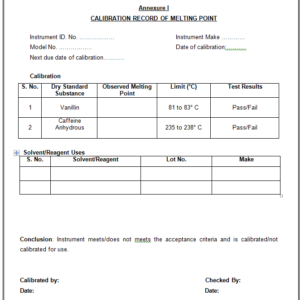
5.2.6 Note the melting point vanillin and record the observation in calibration record Format (Annexure I).
5.2.7 The acceptance criteria are given in Melting point apparatus calibration record Format.
5.2.8 Repeat the same steps for caffeine previously dry over silica gel.
5.2.9 Record the all observation in calibration record format (Annexure I).
5.2.10 Report any discrepancy observed during calibration of instrument to Quality Control
Manager or his designee for corrective and preventive action.
5.2.11 Quality Control Manager or his designee informs the defect to Maintenance Department
service engineer to rectify the defect. Affix ‘Under Maintenance’ label on the instrument.
5.2.12 Calibration should be required after maintenance.
6.0 Reference
In House Specification
7.0 Attachments
Annexure I : Melting Point Calibration Record Format
8.0 Distribution
Distribution of the controlled copy to concerned departments.
Additional copies may be issued for specific purpose.
9.0 Abbreviations
QA : Quality Assurance
QC : Quality Control
SOP : Standard Operating Procedure
oC : Degree Centigrade
10.0 Revision History
| Revision No. | Supersedes | Effective Date | Details of reason |
| 01 | Nil | New SOP |
Operating Procedure of Centrifuge
sop for preparation and storage of reagent solution
sop for Calibration and Maintenance of Laboratory Instruments and Equipment
Disposal of Residual Sample or Left Over Material
sop for for Laboratory Incident
standard operating procedure temperature monitoring
sop for operation of infrared moisture balance
sop for preparation of mobile phase
sop for Preparation and Issuance of Analysis protocol standard
sop of placebo and impurity stock solutions
sop for disposal of residual sample
sop for handling of pharmacopoeial changes
sop for procedure for operation of ultrasonic cleaner
difference between UPLC and HPLC
sop for for Emergency Eyewash and Shower
sop for operation and calibration of total organic carbon analyzers
sop for operation of cobb tester
sop for Operation and calibration of atomic absorption spectrophotometer
sop for Operation and calibration of gas liquid chromatograph
sop for operation of humidity oven
sop for operation and calibration of serological water bath
sop for monitoring of drain trap
sop for destruction of analytical samples after testing and control samples
sop for destruction of used chemicals
Sop for Operation of suction pump
sop for Operation and calibration uv cabinet
sop for Operation and calibration of bulk density apparatus
sop for operation and calibration of shore hardness tester
sop for operation of rub proofness tester
sop for monitoring of purified water
sop for Retesting of packaging materials
sop for Retesting and resampling of raw materials
sop for Control of issuance of record of analysis green sheets
sop for Control of computer passwords
sop for sampling of packaging materials PM
Operation and Calibration Procedure for pH Meter
Calibration of Melting Point Apparatus
Procedure For HPLC column washing procedure
Procedure For Retest Period of Raw Material
Procedure For Training Programme For Quality Control Personnel
Standard Operating Procedure is to provide guidelines for Preparation
Procedure For Analysis of Water rinsing
Procedure For Calibration of Glassware
Procedure For Procurement and storage of reference standards
Procedure For Preparation of buffer solution
safety guidelines for laboratory
responsibilities of quality control and microbiological department
responsibilities of quality control and microbiological department
handling of corrosive hazardous and flammable chemical
calibration of volumetric glassware
operation and cleaning of water bath
testing and approval rejection of bulk finish and packed drug products
procedure for preparation of general test procedures and standard test procedures
disposal of samples chemicals glassware columns
hplc column performance evaluation storage and destruction
operation and calibration of uv cabinet
operation and calibration of refractometer
operation and calibration of digital micrometer