sampling of raw materials
1.0 Purpose
1.1 To describe a procedure for sampling of raw material.
2.0 Scope
2.1 This standard operating procedure is applicable for sampling of raw material at ABC Pvt. Ltd.
3.0 Responsibility
Officer QC/ Executive QC Preparation of SOP and follow the procedure of SOP for the sampling of raw material
Assistant Manager Reviewing and Training of SOP
Manager QC Implementation of SOP
4.0 Accountability
4.1 Manager Quality Control is accountable for implementation and compliance with SOP.
5.0 Procedure
5.1 After the receipt of Raw materials Store In-charge shall prepare ‘Goods Received Note’ (GRN).
5.1.1 After prepare the GRN Store In-charge shall prepare Raw Material Intimation Slip.
5.1.2 Raw Material Intimation Slip consist of following information.
5.1.2.1 Name of material
5.1.2.2 Material code
5.1.2.3 Batch No.
5.1.2.4 Quantity
5.1.2.5 No. of containers
5.1.2.6 Mfg. Date
5.1.2.7 Exp. Date
5.1.2.8 Supplied By
5.1.2.9 Manufactured By
5.1.3 Store personnel shall generate the ‘QUARANTINED’ labels verify its entries from
the GRN and affix them on all the containers received.
5.1.4 Store in-charge forward the GRN and Raw Material Intimation Slip along with manufacture
COA (Certificate of Analysis) to Quality control department.
5.1.5 QC Personnel received the Raw Material Intimation Slip and record the
details in “Raw Material Inward Register”
5.1.6 The Raw material Inward register shall consist of following details:
5.1.6.1 Serial No.
5.1.6.2 Product Name
5.1.6.3 Batch No.
5.1.6.4 Batch Size
5.1.6.5 Manufacturing date
5.1.6.6 Expiry date
5.1.6.7 Mfg. By
5.1.6.8 Supplier by
5.1.6.9 No. of Container
5.1.6.10 Quantity received
5.1.6.11 A.R. No.
5.1.6.12 Receive Date
5.1.6.13 Sampling by Sign./date
5.1.6.14 Analysed by Sign./date
5.1.6.15 Approved by Sign./date
5.1.6.16 Remark
5.1.7 After receipt of relevant documents QC chemist shall check vendor status for the material
(Approved / Under Approval / New Vendor) and Manufacturer / Supplier’s Certificate of Analysis (COA).
5.1.8 However, in exceptional case of non-availability of COA, QC sampling chemist shall proceed
further for sampling but shall release the material preferably only after receiving the relevant documents
from the Manufacturer / Supplier.
5.1.9 Check the consignment details physically and record the observations in the
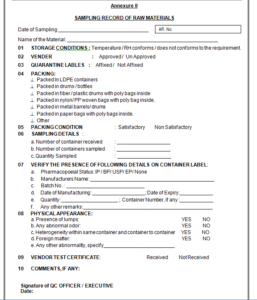
“Sampling Report for Raw Materials” as per Annexure II.
5.1.10 If the condition of the containers in the consignment is found unsatisfactory, keep it aside and intimate Head QA.
Note: Head QA will inspect the same and decide to Accept or Reject the Container.
5.2 Preparation for Sampling
5.2.1 The QC person shall be trained for sampling. The training record of the sampling chemist shall be maintained.
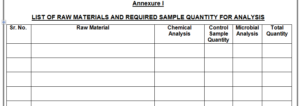
5.2.2 The quantity of raw material to be sampled for test and control sample shall be drawn as per Annexure I.
5.2.3 Samples of Raw Material which are intended for microbiological testing shall be done
by trained Microbiologist as per Annexure I.
5.2.4 The QC personnel shall generate the ‘UNDER TEST’ labels verify its entries from
the GRN and affix them on all the containers received.
5.2.5 The QC person shall consider the respective raw material specification for the purpose of
Pharmacopoeia status, storage condition, approved manufacturer / supplier and sample quantity to be sampled.
5.2.6 QC person shall then prepare “Sampled” labels as per the number of “sampled” label required.
5.2.7 The QC personnel shall take the suitable cleaned sampling tools and the suitable sampling
container (or poly bags, as the case may be) to the store for sampling.
5.2.8 QC personnel shall checks, verify the AR number of the raw material and reconcile
the number of containers and the total quantity. Check the packaging condition of
the containers / packs for any damages etc.
5.2.9 In case of any discrepancies observed during the inspection, QC personnel shall inform
the Quality Control Manager/Quality Assurance Manager and the Store in- charge for corrective action.
5.2.10 The physical condition of the material under sampling shall be recorded
in ‘Sampling Report for Raw Materials’ Refer Annexure II.
5.2.11 Cleaning, drying, sanitization & Sterilization of items shall be taken care off before sampling.
5.2.12 Ensure adequate clothing before entering the sampling area, viz. nose mask, hand gloves, beard mask (if required)
5.2.13 QC personnel shall follow procedure for Entry / Exit as per the SOP shall be displayed at the entrance of Sampling room / booth.
5.2.14 Environmental Monitoring
5.2.15 Sampling Chemist shall check the status of environmental parameter like temperature of
the sampling area before starting the sampling activity and same shall be record in Annexure III.
5.2.16 Before start the sampling, RLAF shall be allowed to stabilize for 15-20 minutes and check
the reading of magnehlic gauge between 05 to 15 mm.
5.2.17 Sampling Chemist shall check the reading of magnehlic gauge of RLAF before starting and
at the end of the sampling activity and same shall be recorded.
5.2.18 To avoid the possibility of contamination, the QC personnel shall not stand, facing the pre-filters of RLAF.
5.2.19 In case of discrepancy / non-conformity for any of the above parameters the sampling
chemist shall inform the Store In-charge and shall start sampling only after the limits as
specified under each pressure gauge is achieved.
5.2.20 Balance in sampling booth shall be checked for proper leveling.
5.2.21 Balance shall be verified with respect to its calibration status.
5.3 Area Clearance
5.3.1 Sampling booth shall be free from previous material and used sampling accessories.
5.3.2 QC chemist shall check the cleaning of RLAF, balance platform floor, sampling kit.
5.3.3 Sampling chemist shall ensure that waste bin with poly bag is in place.
5.4 Material Entry/Exit
5.4.1 Material movement shall be through material door only.
5.4.2 Bring the containers / packs inside the sampling booth and open them carefully after
breaking the seals/ stitching. Ensure that the containers are cleaned externally before
taking them inside the sampling booth.
5.4.3 Movement of material inside & outside sampling booth shall be on trolley.
5.5 Sampling Operation
5.5.1 All the Active raw materials shall be sampled from all the containers i.e.100%.
5.5.2 Sampling of excipients will be carried out as per 1 + √N criteria.
5.5.3 All the containers shall be cleaned externally, from which sample is to be withdrawn and
the containers shall be transferred to the sampling area (reverse laminar flow booth), ensure
that it is functioning properly.
5.5.4 Bring the containers / packs inside the sampling booth and open them carefully after
breaking the seals/ stitching. Ensure that the containers are cleaned externally
before taking them inside the sampling booth.
5.5.5 Material of only one batch No. shall be sampled at a time.
5.5.6 Observe the visual appearance of the material for any abnormality like discoloration,
lumps, non-characteristic odor, foreign matter and physical heterogeneity. In case any
abnormality is observed, reject the entire consignment.
5.5.7 Withdraw approximately equal quantities from the all marked containers/pack to make the
total withdraw quantity equivalent to the quantity specified for sample. The following clean
sampling equipment shall be used to sample different type of raw material.
5.5.8 S.S. liquid sampler: For liquid sampling from drum. Glass pipette with rubber treat: For liquid
sampling from bottle S.S Spatula: For sampling of material from small solid containers S.S. Sampling
rod for sampling of solid raw materials from bags/drums.
5.5.9 Label the bottle/ polybags in which samples are taken with appropriate
‘Pooled sample’ and ‘Reference Reserve sample’ labels. If the sample is collected in a poly bag,
ensure that it is embedded into another polybags so as to avoid cross contamination.
5.5.10 Likewise withdraw some quantity from every container in a separate bottles / poly bags
for identification. Each container shall be checked for identification test only in the case of
active pharmaceutical ingredient.
5.5.11 In case any single container fails for the identification test; the entire consignment shall
be rejected. No part rejection shall be carried out in case any container fails for the identity test.
5.5.12 Close the containers / packs properly after sampling is over and affix ‘SAMPLED’ labels,
which have been duly signed, on the containers which are sampled.
5.5.13 The sampled label shall be pasted over the under test label in such a way that, only
yellow colored portion is totally superimposed and remaining text matter is clearly visible.
5.5.14 Protect the samples from external contaminants like dust, water, and direct sunlight
during sampling and transportation of samples from warehouse to Laboratory.
5.5.15 Use only Pooled sample container for analysis, the Reference reserve sample container shall
be stored in the Reference reserve sample room after entering the necessary details in
the ‘Reference Reserve Sample Register for Raw Materials’ maintained in QC laboratory.
5.5.16 The pooled sample for analysis shall be tested as per the laid down specifications and
Standard test procedure of the respective material.
5.5.17 For liquid sample, take the sample from the container with the help of glass sampler.
Transfer the sample to the stopper flask or bottle. Label the details of the sample and bring to
the lab for testing. No reference. Sample shall be stored for the liquid raw materials, except API.
5.5.18 Ensure that the materials received in the Warehouse are sampled within 05 days from the
date of receipt. However, if the priority requirement differs, the same can be extended by another 05 days.
5.5.19 Area cleaning after sampling, shall be done and records shall be maintained in annexure III.
5.6 Re-Testing of Raw materials
5.6.1 The re-testing of active materials and excipients materials shall be one year from the date of approval.
5.6.2 Re-testing date of active materials and excipients materials is one year from the date of
approval but it not exceeding the expiry date of materials.
5.7 Requisition for extra Raw material (For Working Standard or any other requirement)
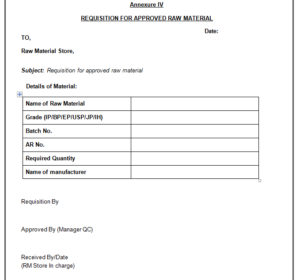
5.7.1 QC designated person shall prepare a requisition note (Annexure IV) and after getting
approval from Head – QC, the requisition shall be submit to warehouse – in charge.
5.7.2 Warehouse personnel shall dispense the approved quantity of the raw material to
quality control laboratory, on the basis of requisition.
6.0 Reference
In house specification
WHO Technical Report Services -929
7.0 Attachments
Annexure I : List of raw materials and required sample quantity
Annexure II : Sampling Report for Raw Material
Annexure III : Sampling Activity Record
Annexure IV : Requisition of approved Raw material
8.0 Distribution
Distribution of the controlled copy to concerned departments.
Additional copies may be issued for specific purpose.
9.0 Abbreviations
QA : Quality Assurance
QC : Quality Control
SOP : Standard Operating Procedure
RLAF : Reverse Laminar Air Flow
10.0 Revision History
| Revision No. | Supersedes | Effective Date | Details of Revision |
| 01 | Nil | New SOP |
Operating Procedure of Centrifuge
sop for preparation and storage of reagent solution
sop for Calibration and Maintenance of Laboratory Instruments and Equipment
Disposal of Residual Sample or Left Over Material
sop for for Laboratory Incident
standard operating procedure temperature monitoring
sop for operation of infrared moisture balance
sop for preparation of mobile phase
sop for Preparation and Issuance of Analysis protocol standard
sop of placebo and impurity stock solutions
sop for disposal of residual sample
sop for handling of pharmacopoeial changes
sop for procedure for operation of ultrasonic cleaner
difference between UPLC and HPLC
sop for for Emergency Eyewash and Shower
sop for operation and calibration of total organic carbon analyzers
sop for operation of cobb tester
sop for Operation and calibration of atomic absorption spectrophotometer
sop for Operation and calibration of gas liquid chromatograph
sop for operation of humidity oven
sop for operation and calibration of serological water bath
sop for monitoring of drain trap
sop for destruction of analytical samples after testing and control samples
sop for destruction of used chemicals
Sop for Operation of suction pump
sop for Operation and calibration uv cabinet
sop for Operation and calibration of bulk density apparatus
sop for operation and calibration of shore hardness tester
sop for operation of rub proofness tester
sop for monitoring of purified water
sop for Retesting of packaging materials
sop for Retesting and resampling of raw materials
sop for Control of issuance of record of analysis green sheets
sop for Control of computer passwords
sop for sampling of packaging materials PM
Operation and Calibration Procedure for pH Meter
Calibration of Melting Point Apparatus
Procedure For HPLC column washing procedure
Procedure For Retest Period of Raw Material
Procedure For Training Programme For Quality Control Personnel
Standard Operating Procedure is to provide guidelines for Preparation
Procedure For Analysis of Water rinsing
Procedure For Calibration of Glassware
Procedure For Procurement and storage of reference standards
Procedure For Preparation of buffer solution
safety guidelines for laboratory
responsibilities of quality control and microbiological department
responsibilities of quality control and microbiological department
handling of corrosive hazardous and flammable chemical
calibration of volumetric glassware